
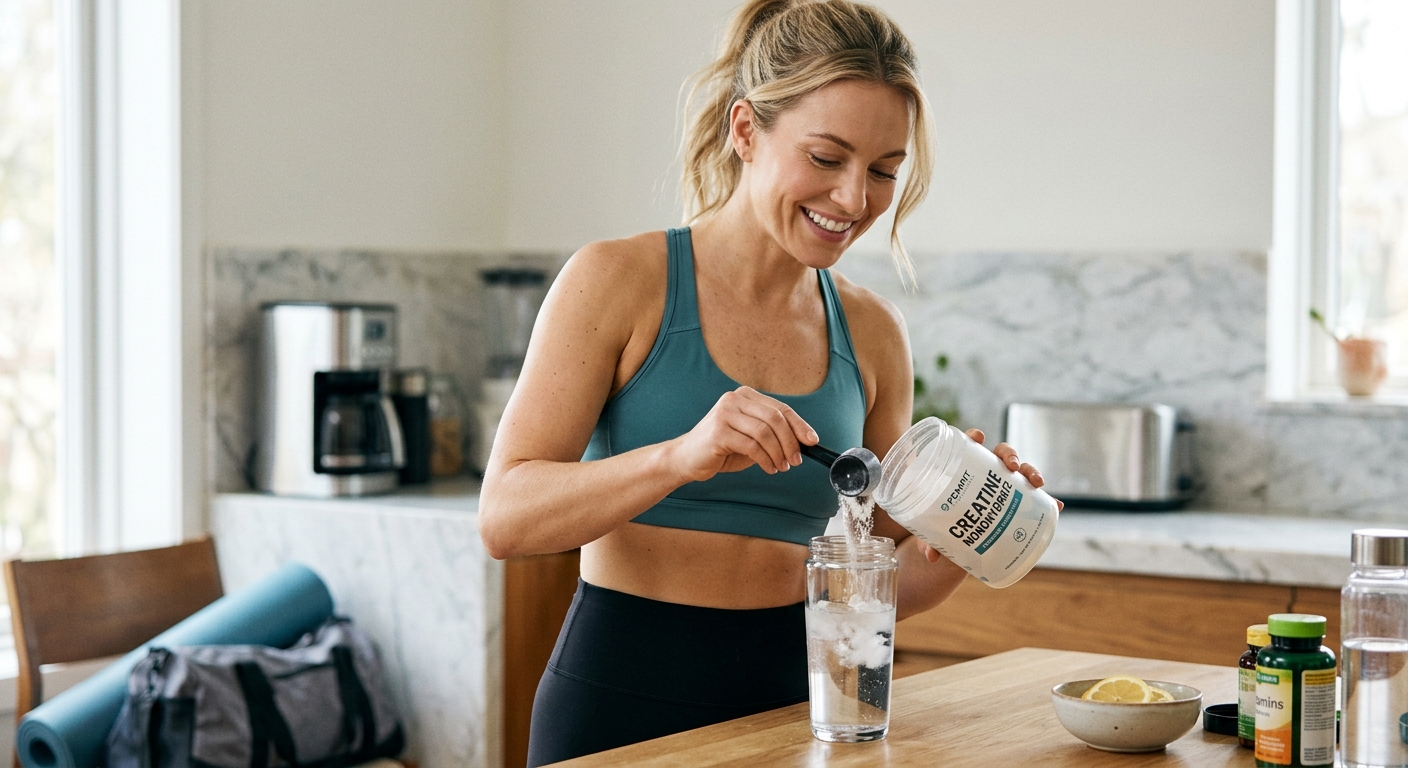
Creatine for women has a branding problem, not a science problem. If you’ve spent any time in the supplement aisle, you’ve probably walked straight past the creatine tub without a second thought. It’s always felt like a “bodybuilder thing” — big tubs, bigger dudes, not really relevant to you. Here’s the problem with that: almost all of that reputation was built on research done in men. Women barely featured in the studies for decades.
That’s finally starting to change, and what’s coming out of the newer research is genuinely worth your attention.
What Creatine Is Actually Doing in Your Body
Creatine helps your muscles regenerate energy faster during short, intense efforts — a heavy set, a sprint, a round of boxing pads. Practically, that means a bit more power when it counts, and often quicker recovery between efforts. It also helps your muscles store more glycogen, which matters more than it sounds like — we’ll get to why in a minute.
Why Research on Creatine for Women Has Lagged Behind
A 2025 review out of the University of North Carolina, led by Dr Abbie Smith-Ryan, basically said the quiet part out loud: women have always been underrepresented in exercise science, and even more so in creatine research specifically. That matters, because your physiology — your cycle, pregnancy, the menopause transition — genuinely changes how your body uses creatine. The science is only just starting to catch up. So this is still an evolving area, not a fully settled one, and we’ll be upfront about that as we go.
Where The Most Promising Data Is Right Now: Perimenopause
This is genuinely the most interesting part. Dr Smith-Ryan has pointed out that there’s decent data on creatine after menopause, but the transition itself — when sleep, bone health, muscle, joints and brain fog all start shifting at once — has barely been studied. If you want the fuller picture of that stage, our guide on menopause and fitness covers it in depth.
A small 2025 study out of St Olaf College followed 15 women (5 perimenopausal, 10 postmenopausal) through 14 weeks of twice-weekly strength training combined with creatine. Lower-body strength went up across the board, and the perimenopausal group specifically saw a real improvement in sleep quality. To be clear — that’s 15 women, not 1,500. It’s a small, well-designed pilot study, and it’s promising, not proof.
A slightly bigger trial (36 women, 8 weeks) looked at lower doses of creatine and found improvements in reaction time along with measurable increases in brain creatine — an early but interesting signal for the brain-fog side of the menopause transition.
The Insulin Sensitivity Connection — and Where We Need to Be Careful
Here’s where it gets relevant to hormonal health specifically, and where we want to be really precise with you. Creatine increases glycogen storage, and actively working muscle pulls more glucose out of your bloodstream to use as fuel — a pathway that can genuinely improve how efficiently your body handles blood sugar.
There is a real, published trial showing creatine plus exercise improved insulin sensitivity in insulin-resistant women. What it did not study was women specifically diagnosed with PCOS (now officially renamed Polyendocrine Metabolic Ovarian Syndrome, or PMOS, as of a global consensus published in The Lancet this past May). No dedicated PCOS-and-creatine trial exists yet.
So the honest way to say this: creatine may support the same insulin-sensitivity benefits that resistance training already gives you — not that it’s a proven, stand-alone PCOS treatment. We’d rather tell you that clearly than oversell it.
The Practical Bit
- Most studied doses sit around 3–5g a day of creatine monohydrate
- It works best paired with resistance training — not sat in a drawer
- Stay well hydrated, as standard advice
- If you’re pregnant, have any kidney condition, or are on medication, talk to your doctor first — the data specifically around pregnancy and perimenopause is still limited
This is exactly the kind of call we’d rather make with you than for you — based on where you’re at, your training, and your goals, not a blanket “everyone should take this” line.
Not Sure Where to Start?
If you’re curious whether creatine fits into your training and where you’re at hormonally, that’s a conversation worth having with someone who actually looks at the whole picture. Book a free consultation and we’ll figure out what makes sense for you.

