
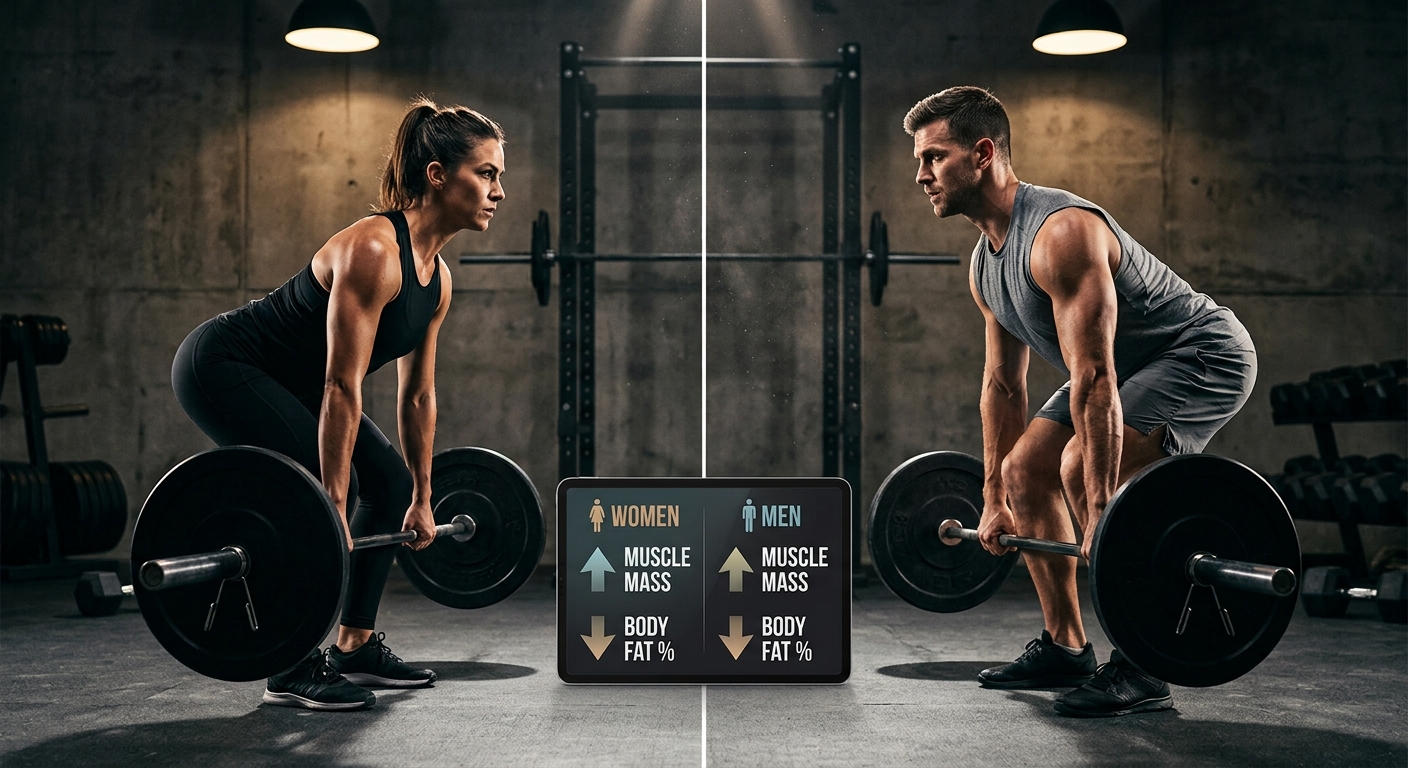
Body recomposition is real, and it’s exactly what we build every programme around. For years, “you can’t build muscle and lose fat at the same time” was treated as gospel in the fitness world. Turns out that’s an oversimplification — and once you understand why, it changes how a fat-loss plan should actually be built (we go deeper on this in how to lose fat without losing muscle).
Body Recomposition: What It Actually Means
Body recomposition is losing fat while gaining or holding onto muscle, at the same time. It used to sound like a contradiction — fat loss needs a calorie deficit, muscle-building usually needs surplus energy. A 2024 review looking at the current state of this research confirmed something important: recomposition genuinely happens, across people who are untrained, trained, and highly trained, and across a wide age range. The real question these days isn’t whether it’s possible — it’s who sees it happen fastest, and under what conditions.
Who Sees It Happen Fastest
If you’re newer to structured training, or coming back to it after time off, you’re likely to see this happen relatively easily — that’s just how your body responds early on. If you’re already lean and well-trained, it’s still achievable, but it takes more precision around protein and training volume to see real change. One study worth knowing specifically: research on older women doing resistance training found that moderate-to-higher protein intake led to noticeably better recomposition — a useful, women-specific finding in a field that’s mostly studied younger men.
The Two Things That Actually Matter
Resistance Training
This is the one modality consistently linked to recomposition, whatever style or equipment you use — see also why strength training is the best exercise for women over 40. The real driver is progressive overload — steadily asking a bit more of your muscles over time — not any particular workout trend.
Protein
Across the sports nutrition research, protein is the main nutritional lever here. General guidance sits around 1.4–2.0g per kilo of bodyweight a day for most people building or holding onto muscle — and that climbs to 2.3–3.1g per kilo for people training seriously while in a calorie deficit, since a deficit alone makes it harder to hang onto muscle, and higher protein helps offset that.
The Things People Underrate
- Sleep (7–9 hours): skimp on it and you get worse muscle repair and hungrier — working against you from both directions at once
- Stress: chronically high cortisol is linked to more fat stored around your middle, independent of what you’re eating
- A realistic timeline: real, measurable recomposition tends to show up over 8–24 weeks in the research — not days. Because you’re often losing fat and gaining muscle simultaneously, the scale can barely move even while your actual body is changing a lot. This is exactly why we care more about measurements, photos and how your clothes fit than the number on the scale during this process.
Why This Beats “Just Eat Less”
Generic cardio-plus-deficit plans tend to produce weight loss that includes real muscle loss — which looks like “progress” on the scale while actually working against your metabolism, strength, and how your body actually looks and feels long term. Recomposition-focused coaching — proper resistance training, enough protein, and patience — is what actually reshapes your body, not just the number on a scale.
Want a Plan Built Around Recomposition, Not the Scale?
If you’re tired of chasing a number instead of an actual result, book a free consultation and let’s build a programme around what’s really changing your body.


